Managed Grassland Carbon Dynamics
Carbon Dynamics in Managed Grasslands
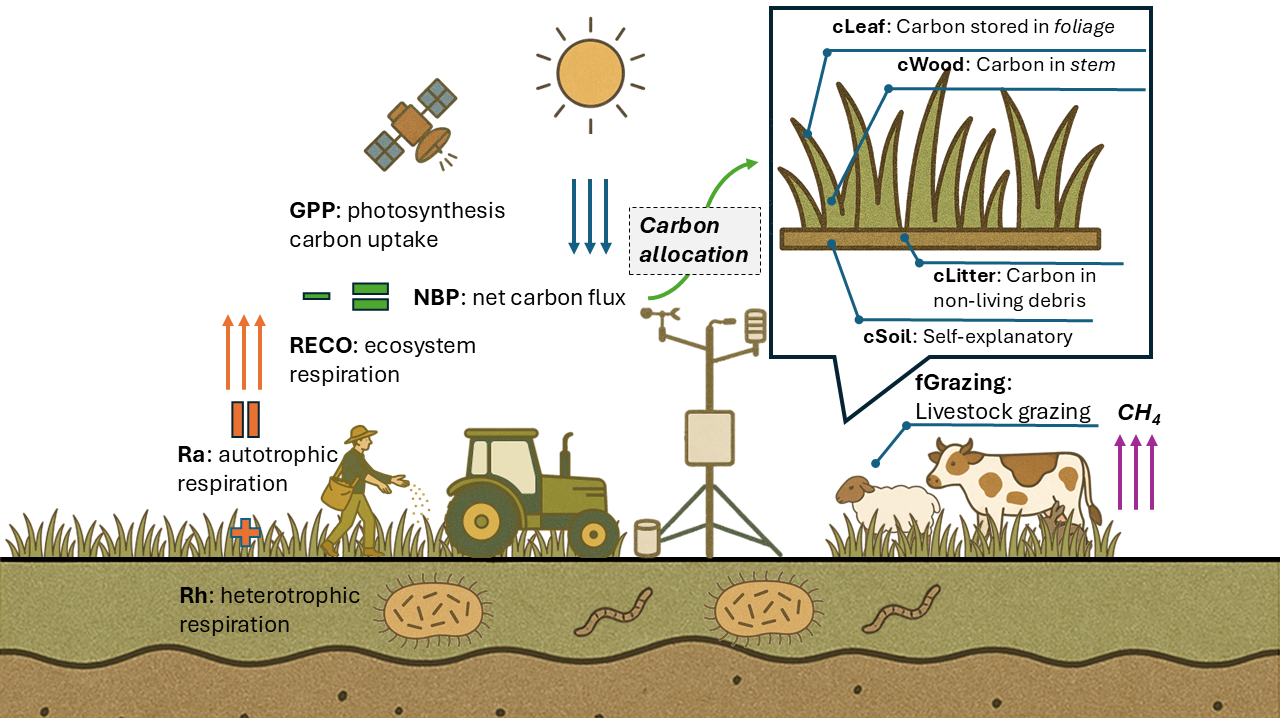
Grasslands cover 40% of the UK’s land area, with 80% of them managed through agricultural practices like livestock grazing and fertiliser applications. A typical managed grassland ecosystem – such as North Wyke at Rothamsted Research in southwest England – includes key contributors to the carbon cycle:
- Vegetation (mainly perennial ryegrass: Lolium perenne, AberMagic, and AberHerald)
- Soil microbes
- Livestock and humans
- Other organisms (e.g., insects and rodents)
Carbon Dynamics in Managed Grasslands
Carbon cycling in these ecosystems is classified into carbon stocks and carbon fluxes:
- Stocks (pools) store carbon, similar to organs in a body.
- Fluxes move carbon between pools, akin to blood circulation.
The primary carbon input is through vegetation photosynthesis, measured as gross primary productivity (GPP). Part of GPP is used by plants for growth and maintenance (autotrophic respiration, Ra), while soil microbes respire another portion (heterotrophic respiration, Rh). The total respiration of the ecosystem is called ecosystem respiration (RECO). The difference between GPP and Ra is known as net primary production (NPP).
The net exchange of carbon between the ecosystem and the atmosphere is given by:
NEE = -NEP = RECO − GPP = Ra + Rh − GPP = Rh − NPP
where NEE (net ecosystem exchange) represents the net flux of CO2. The negative of NEE is net ecosystem production (NEP), which accounts for how much carbon is retained in the ecosystem. If we consider additional disturbances, such as animal respiration, the remaining carbon is net biosphere production (NBP) – which is then allocated to different carbon pools.
Carbon Pools in Vegetation and Soil
Carbon within a managed grassland is stored in different pools, each with a unique role in the ecosystem:
- cLeaf: Carbon stored in leaves, which plays a crucial role in photosynthesis and short-term carbon cycling. Leaves have high turnover rates, contributing to litter production.
- cWood: Carbon stored in stems and woody biomass (mostly relevant in tree-dominated ecosystems but minimal in grasslands). The sum of cLeaf and cWood is Aboveground biomass (AGB), representing all carbon in plant structures above the soil surface.
- cVeg (vegetation carbon): The total carbon in plants, including both aboveground biomass and belowground biomass (roots), which is important for soil carbon input and long-term storage.
- cLitter (litter carbon): Carbon in plant debris, such as fallen leaves, dead roots, and decomposing organic material. Litter decomposition releases carbon back into the soil and atmosphere.
- cSoil (soil organic carbon, SOC): Carbon stored in the soil, one of the largest and most stable reservoirs in grassland ecosystems. SOC results from plant material decomposition, root exudation, and microbial activity, playing a key role in long-term carbon sequestration.
Agricultural Management & Greenhouse Gas Emissions
In managed grasslands, livestock grazing influences carbon cycling by affecting plant regrowth, soil carbon inputs, and nutrient cycling. Additionally, livestock are a significant source of methane (CH4) – a greenhouse gas 80 times more potent than CO2 over a 20-year period. Methane emissions primarily come from enteric fermentation in ruminants and manure decomposition.
UFLUX Workflow
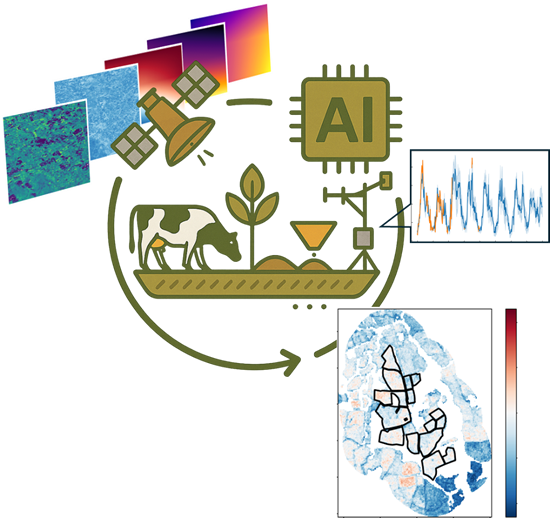
The Unified FLUXes (UFLUX) model is a physics-based machine learning ecosystem model that integrates multiple data sources and modelling to estimate carbon fluxes. It combines Earth observations (Sentinel-2 Near-Infrared Reflectance of Vegetation, NIRv), Sentinel-1 backscatter data, and Sentinel-5P with climate reanalysis datasets (such as ERA5 air temperature and vapor pressure deficit, VPD) to run a baseline ecosystem model for estimating gross primary productivity (GPP), ecosystem respiration (RECO), and net ecosystem production/exchange (NEP/NEE).
Artificial intelligence is then applied to learn the residuals between the baseline model predictions and eddy covariance flux measurements, enabling a correction that improves the accuracy of carbon flux estimates across entire fields. To model carbon allocation and grazing impacts, the TRENDY (trends in net land–atmosphere carbon exchanges) international models are used to determine how carbon uptake is distributed among different carbon pools. Additionally, statistical analysis is incorporated to assess the effects of land management on carbon dynamics.
References
Zhu, S., Quaife, T. and Hill, T., 2024. Uniform upscaling techniques for eddy covariance FLUXes (UFLUX). International Journal of Remote Sensing, 45(5), pp.1450-1476.
Cardenas, L.M., Olde, L., Loick, N., Griffith, B., Hill, T., Evans, J., Cowan, N., Segura, C., Sint, H., Harris, P. and McCalmont, J., 2022. CO2 fluxes from three different temperate grazed pastures using Eddy covariance measurements. Science of the Total Environment, 831, p.154819.
Zhu, S., Xu, J., Zeng, J., He, P., Wang, Y., Bao, S., Ma, J. and Shi, J., 2024. UFLUX-GPP: A cost-effective framework for quantifying daily terrestrial ecosystem carbon uptake using satellite data. IEEE Transactions on Geoscience and Remote Sensing.
Dong, W., Zhu, S., Xu, J., Ryan, C.M., Chen, M., Zeng, J., Yu, H., Cao, C. and Shi, J., 2025. UFLUX v2. 0: A Process-Informed Machine Learning Framework for Efficient and Explainable Modelling of Terrestrial Carbon Uptake. IEEE Geoscience and Remote Sensing Letters.
Zhu, S., Olde, L., Lewis, K., Quaife, T., Cardenas, L., Loick, N., Xu, J. and Hill, T., 2023. Eddy covariance fluxes over managed ecosystems extrapolated to field scales at fine spatial resolutions. Agricultural and Forest Meteorology, 342, p.109675.
